The Power of Great Darkness: will we fend-off its paw-strokes at the heart?
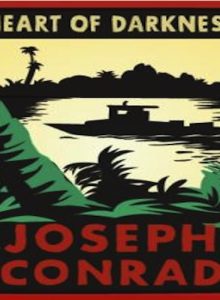

Floundering down the Congo River in Central Africa incarcerated by an impenetrable jungle on a decrepit paddle steamer manned by cannibals, Captain Charles Marlowe remarks:
“Not the faintest sound of any kind could be heard. You looked on amazed and began to suspect yourself of being deaf—then night came suddenly, and struck you blind as well.”
I promise you that you will turn the pages of this mysterious tale rapidly, and as you do, the word ‘darkness’ will be redefined. The first days of 19th-century colonization of this massive continent, in pursuit of ivory and gold to line the walls of European palaces, transported ambitious white men into an unimaginable darkness at its heart.
I admire this poetic writing so much—see above. Conrad (1857-1924) was Ukrainian-born (this seems a fitting time to praise the progeny of this troubled country) of exiled Polish parents. He arrived alone in England in his twenties to make his way as a Merchant Navy man and was inspired to write ‘Heart of Darkness’ directly in English (his third language after Polish, French and Russian) extrapolating from his ship’s diary. In fact, he did experience a brief, unsuccessful expedition to the Congo in 1890.
Conrad’s writing oozes exquisite imagery and metaphors; his use of English is fresh in ways you can’t quite put your finger on. But the way he lays out his writing is a little tricky because his paragraphs are long, which we’re unaccustomed to today. This is because many Victorian novels first appeared as weekly, monthly or quarterly serialized episodes, which publishers later turned into books. ‘Heart of Darkness’s’ first appearance was in Blackwood’s Edinburgh Magazine (CLXV) in three parts, one for February, March and April editions of 1899.
When I reread it—I had to read it several times when I was younger because it was an English Literature Examination text—because I wanted to, I needed a break from the narrative to get my mind around this kind of darkness. However, despite having no space to breathe in because the action is unstoppable, the narrative compelled me to continue deeper into the heart with Marlowe and his strange characters. By the way, it’s a novella, not a full-scale novel, so it took me about 2.5 hours to read.
Marlowe (Conrad) starts to tell his incredible Congo story to draw his shipmates in aboard a different boat on the Thames River, London—a ship with sails—‘The Nellie,’ a cruising yawl. His silver tongue drags us with him into the great darkness against an incredible sunset.
“Only the gloom to the west, brooding over the upper reaches, became more somber every minute, as if angered by the approach of the sun. And at last, in its curved and imperceptible fall, the sun sank low, and from glowing white changed to a dull red without rays and without heat, as if about to go out suddenly, stricken by death by the touch of that gloom brooding over a crowd of men.”
After being highly recommended for transporting ivory via the one-way route, the River Congo, and arriving there, we witness several months of frustration. His steamer has been run aground and severely damaged, and there is not a rivet to be had in the jungle to repair it. The first glimpse of the black-skinned enslaved people chained at the neck is shocking. At one time, blasting is underway around the station he is waiting at, the earth shuddering, and some of the helpers withdraw.
“Black shapes crouched, lay, sat between the trees leaning against the trunks, clinging to the earth, half coming out, half effaced within the dim light, in all the attitudes of pain, abandonment, and despair……. They were dying slowly—it was very clear. They were no enemies, they were not criminals, they were nothing earthly now, nothing but black shadows of disease and starvation, lying confusedly in the greenish gloom.”
“…These moribund shapes were free as air–and nearly as thin.”
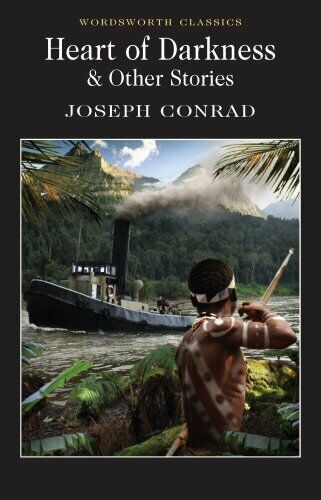
Once afloat, passage on the salvaged wreck of the paddle steamer deep into the heart of the Congolese jungle is slow and hazardous. His crew is unskilled, and he keeps the seething savages port and starboard on the banks at bay with the ship’s whistle, which is a terrifying being to them. He meets several intriguing characters; two are notable: the brickmaker—an aristocrat with no materials for making bricks; and the itinerant Russian harlequin, Kertz’s nurse and number one apostle.
Once fog besieges them so thick, they anchor until it clears. Blind to the shore, natives attack them with showers of arrows and spears. And amidst all these insurmountable obstacles, everyone is focused on getting to Mr Kertz, the central station manager, as if he is a god, which Marlowe cannot understand, having not yet met him. Marlow’s trusted helmsman dies impaled at his feet and he conducts a brief funeral ritual, throwing him overboard, much to the chagrin of the other crew members who want him for food.
Then, as the steamer arrives at the Central station, they see strange poles with spherical tops surrounding a ruined house. Marlow peers at them through his binoculars only to discover they are human heads drying in the sun. At the sound of their docking, out of the jungle wall or, it seems, the earth, stretcher bearers carry Mr. Kertz, a shaven-headed cadaver whose unexpectedly strong voice prevails over the silent prehistoric beast of the jungle.
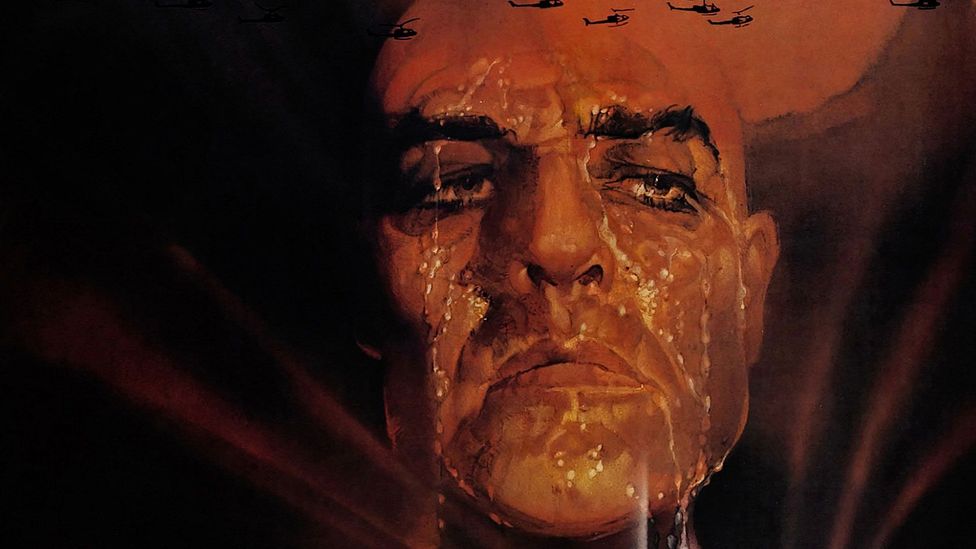
Colonel Walter E. Kurtz (marlon Brando) in Apocalypse Now
Marlowe is charged with taking him and his ivory cargo back upriver if he can make it. His tribal carers are loathed to see him depart, and their Queen—’a wild and gorgeous apparition of a woman,’ —is angry and deprived.
“She walked with measured steps, draped in striped and fringed cloths, treading the earth proudly, with a slight jingle and flash of barborous ornaments. She carried her head high; her hair was done in thebshape of a helmet; she had brass leggings to the knee, brass wire gauntlets to the elbow, a crimson spot on her tawny cheek, innumerable becklaces of glass beads on her neck; bizarre things, charms, gifts of witch men, that hung abotu her, glittered and trembled at every step. She must have had the value of several elephant tusks upon her. She was savage and superb, wild-eyed and magnificent…….”
You can also listen to this passage on audio to see how Conrad’s language resonates to make a vivid and terrifying image of her.
Kertz tries to go back to them, crawling on all fours to complete the process of taming them, but Marlowe resists the urge to finish him off and retrieves him. Kertz does not survive for long, but he and Marlowe get acquainted and he entrusts Marlowe to guard his papers and personal effects. His death is gruesome; his final words,’ Horror! Horror!’
Although sick and nerve-stricken, Marlowe completes his mission smoothly and returns to London. He takes a long time to recover from his descent into the Heart of Darkness, nursed by his favourite aunt, but eventually goes in search of Kertz’s intended to hand over the effects.
She is beside herself with grief and denial, but Marlowe is duty-bound to give her the details of her betrothed’s final days and death. She urgently wants to know his last words, and Marlowe lies and reassures her that her name is the last thing he uttered.
If film directors turn a book into a film, we may find one or the other a disappointing representation of the story, characters, etc. In this case, however, the book inspired an outstanding film, ‘Apocalypse Now.’ Still, Francis Ford Coppola, the director, decided to set the story in Vietnam at the end of the war in which so many young American soldiers died or were maimed pointlessly. If you have never seen this 2001 classic, please watch it. It also takes us down a scary river deep into the heart of a terrible oriental form of darkness. It is therefore quite different to the book in so many ways.
https://youtu.be/9l-ViOOFH-s?si=llJkDCxFLHeLV7YE
Video trailer Apocalypse Now (1979)
When Conrad produced this novella, other famous writers were:
-
- Henrik Ibsen (1828-1906), the Norwegian playwright and director
- Sigmund Freud (1856-1939), the father of modern psychology
- Stephen Crane (1971-1900), American poet and novelist
- Scott Fitzgerald (1896-1940), American novelist, essayist & short story writer
- Mark Twain (1835-1910), American writer and humorist
‘Heart of Darkness’ had to follow in the footsteps of similar adventure blockbuster books like ‘Moby Dick’ by Herman Melville (1851), ‘Twenty-thousand Leagues Under the Sea’ by Jules Verne (1870) and ‘Frankenstein’ by Mary Shelley (1818). But Conrad was one of the last Victorians and is often seen as a modern author. In fact, ‘Heart of Darkness’ has been banned and still is for school children in some regions of the US as racist. Critics berated Conrad for representing white as good and black (darkness) as evil or bad. All that Karl says is true and the questions, preconceptions and confrontations are necessary in a global world, in my view.
“It (Heart of Darkness) asks troublesome questions, disturbs preconceptions, forces curious confrontations, and possibly changes us.”…’ ‘the 19th century becomes the twentieth.”
Frederick R Karl, A Reader’s Guide to Joseph Conrad, 1960
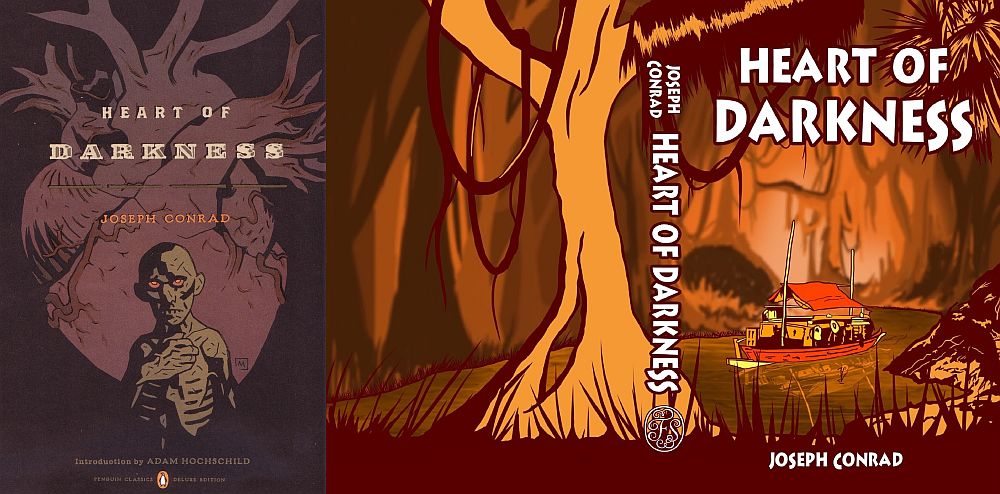
In conclusion, ‘Heart of Darkness’ is an invitation to journey into the darkness in your own heart as it was for Conrad. His isolation and endless time for self-reflection while at sea on long voyages made him introspective and, some say, melancholic. I have succeeded in confronting my inner darkness or shadow, which I believe every human being has and never more so than in this era of robots and internet frenzy. I have survived the clawing of the prehistoric wilderness at my heart and come to a place of clarity and appreciation of my humanity and goodness thanks to Conrad allowing me into his inner world.
The power of darkness is potentially overwhelming, but being shrouded in the darkness at the heart of one of the most primitive places on earth has brought me into a marvellous light and hope for the human race. The potent resonance of the words Conrad chooses and repeats for effect, e.g. brooding, gloom, wilderness, prehistoric, stillness, silence, in his poetic voice, is astounding, haunting.
I leave you with a final quotation which will, I’m confident, persuade you to go with Marlowe into the Heart of Darkness as I did:
“We penetrated deeper and deeper into the heart of darkness. It was very quiet there. At night sometimes the roll of drums behind the curtain of trees would run up the river and remain sustained faintly, as if hovering in the air high over our heads, till the first break of day. Whether it meant war, peace, or prayer, we could not tell. The dawns were heralded by the descent of a chill stillness; the woodcutters slept; their fires burned low; the snapping of a twig would make you start. We were wanderers on a prehistoric earth, on an earth that wore the aspect of an unknown planet.”
Question? Which should you do first? Watch ‘Apocalypse Now’ or read ‘Heart of Darkness?’
Answer. Without a doubt, I would read ‘Heart of Darkness’ first. The film then adds to your experience in a cinematic way but it can never reflect Conrad’s language.